Hi travel buddies! Great news for all women because National Museum of the Philippines is giving free access to all its female visitors throughout the month of March! Yey! This is in line with the celebration of "National Women's Month". So what are you waiting for girls? Go and grab your shoes and avail this gift from the National Museum with your girlfriends. You could visit the National Museum in Manila, Kiangan, Kabayan, Angono-Binangonan Petroglyph Site, Tabaco, and Butuan to discover the rich culture and history of our country.
So let us now start the second part of our expedition inside the National Museum of the Philippines! I present to you the National Art Gallery, art enthusiasts will surely like this place because it is a home for hundreds of art pieces made by great artists.
So let us now start the second part of our expedition inside the National Museum of the Philippines! I present to you the National Art Gallery, art enthusiasts will surely like this place because it is a home for hundreds of art pieces made by great artists.
National Art Gallery

 I remember the first time I visited the National Art Gallery with my friend, we only have 20 minutes to tour around so we didn't have much time to appreciate every piece of art.We're actually running around just to have a glimpse in each gallery and we didn't have the opportunity to tour around the remaining floors of the building cause it's already closing time. And for our second visit last Wednesday we had our comeback and we tour around for 1 hour! yey!


As we entered the building of the National Art Gallery we were welcomed by the largest painting in our country, Juan Luna's "Spoliarium". And we were really happy that at last we have a souvenir photo with that one of a kind enormous piece of art.

So to share for some fun facts that I read on the National Museum's official website, "Spoliarium is a Latin word referring to the basement of the Roman Colosseum where the fallen and dying gladiators are dumped and devoid of their worldly possessions. The Spoliarium is the most valuable oil-on-canvas painting by Juan Luna, a Filipino educated at the Academia de Dibujo y Pintura (Philippines) and at the Academia de San Fernando in Madrid, Spain. With a size of 4.22 meters x 7.675 meters, it is the largest painting in the Philippines. A historical painting, it was made by Luna in 1884 as an entry to the prestigious Exposicion de Bellas Artes (Madrid Art Exposition, May 1884) and eventually won for him the First Gold Medal."
Let us now start entering the galleries on second floor, which was originally the Old House of Representatives Session Hall.
Gallery I: Luis I. Ablaza Hall
It features religious art from 17th to 19th centuries when Philippines was still under the Spanish colonial rule.
 |
| "Retablo" or altar piece from the Churcch of San Nicolas de Tolentino in Dimiao, Bohol |


These two are examples of carved wooden saints made by unknown artists.
Gallery II: FCCP Hall
This gallery exhibits the earliest Philippine paintings depicting a historical political event, The Basi Revolt series by Esteban Villanueva of Vigan. Painted in 1821, fourteen paintings, together declared as a National Cultural Treasure.

Gallery III: Academic and Romantic Art
So obviously this gallery exhibits paintings that are academic and romantic.
 |
| "La Natividad" by Unknown Artist of Bohol |
 |
| "Portrait of Three Ladies" by Unknown Artist |
It exhibits academic and neoclassical sculptures

 |
| "Figure of a Lion" by Vidal A. Tampinco |
This gallery honors our national hero, Dr. Jose Rizal. It features his life artworks and works by other national artists to pay tribute for our great hero.
 |
| "Portrait of Dr. Jose Rizal" (1950) by Tomas Bernardo |


Gallery VI: Far East Bank and Trust Company-Andres and Grace Luna de San Pedro Memorial Hall
This gallery exhibits paintings of "Los Dos Pintores" Juan Luna and Felix R. Hidalgo.


Gallery VII: Classical Art from the 20th Century
This gallery still features the works of Juan Luna and Felix Hidalgo. Also, the works of other artists like Fernando Amorsolo, Ireneo Miranda and many other artists who developed the Philippine art.
 |
| "Portrait of a Lady" (1952) by Ireneo L. Miranda |
This gallery exhibits the hardships of Filipinos during the World War II. Filipino artists used their talent to pay tribute to the victims of the Bataan Death March and the destruction of Manila.
 |
| "The Burning of Manila" (1942) by Fernando C. Amorsolo Oil on Masonite |

 So the picture on the left is made out of wood and metal entitled the "Bataan Death Marcher" (undated) by Gene Cabrera. The picture on the opposite side is a painting made by Diosdado M. Lorenzo in the year 1947 entitled " Rape and Massacre in Ermita". These artworks tells a lot about the history of World War II and I felt sad while looking at those pieces of art, cause it made me realize how hard the Filipinos suffered during that era.
Gallery IX: Works of Portraiture
This gallery exhibits portraits made by Filipino artists of the classical realist school. This kind of medium was dominated by our National Artist Fernando Amorsolo together with numerous other artists including, Fabian de la Rosa, Jorge Pineda, Romeo Enriquez and a lot more.
 |
| "Portrait of a Lady (unfinished)" by Fernando Amorsolo (circa 1972) This painting was actually being worked upon by the artist, but due to a heart failure he died on April 24, 1972 at the age of 79. |
 |
| "Portrait of Manual L. Quezon (1878-1944) as President" (1948) by Romeo B. Enriquez |
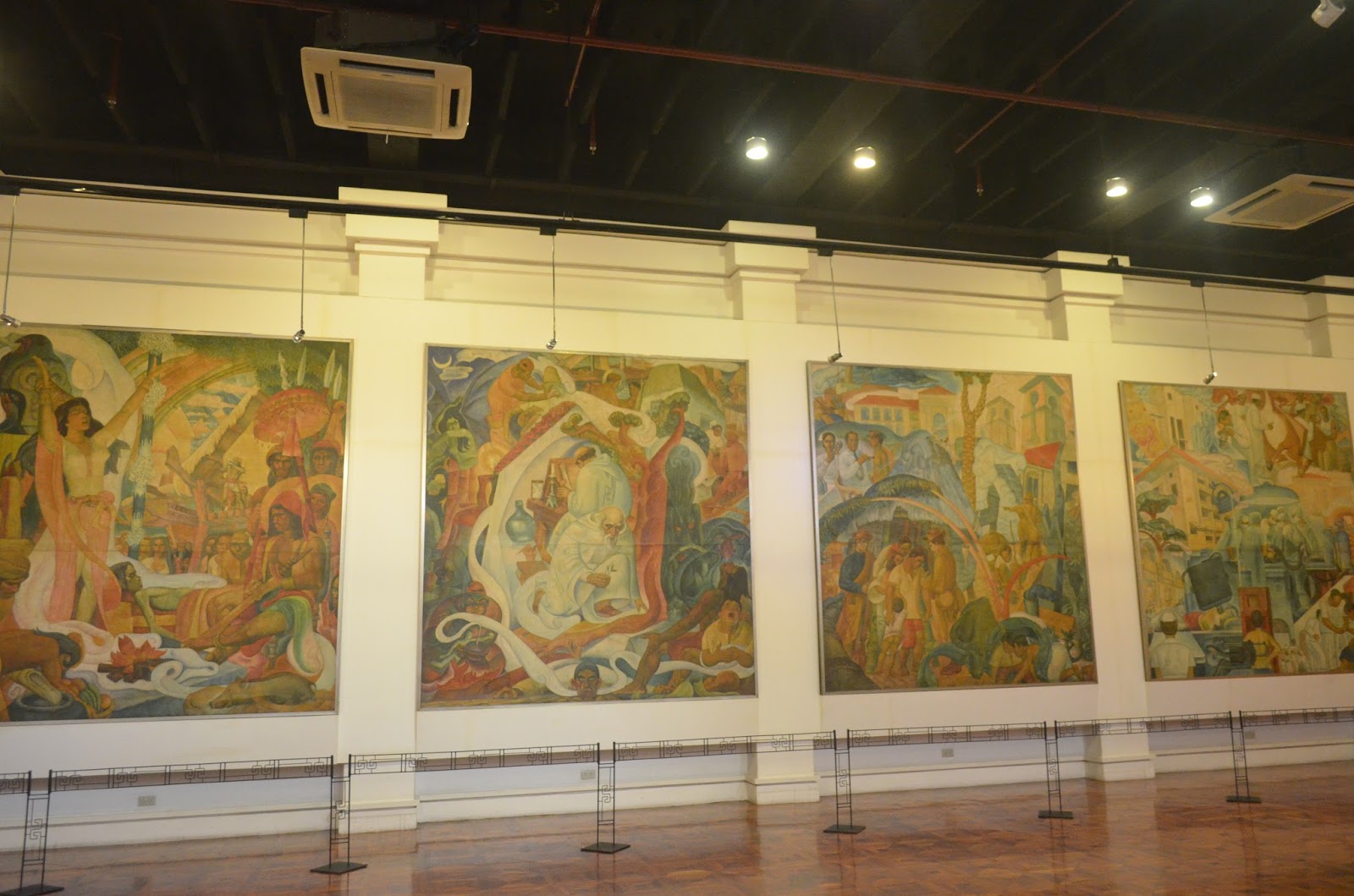
This hall is dedicated to the Progress of Medicine in the Philippines, a set of four large-scale paintings by National Artist Carlos "Botong" V. Francisco (1912-1969).

Gallery XI: SPPC Hall
This hall exhibits the drawings of Fernando C. Amorsolo. It contains over 100 drawings by Amorsolo, who made a series of black-and-white pencil and ink sketches.


Gallery XII: Security Bank Hall
This gallery features National Artist Guillermo E. Tolentino (1890-1976) who dominated Filipino sculpture during 1920s to 1970s.

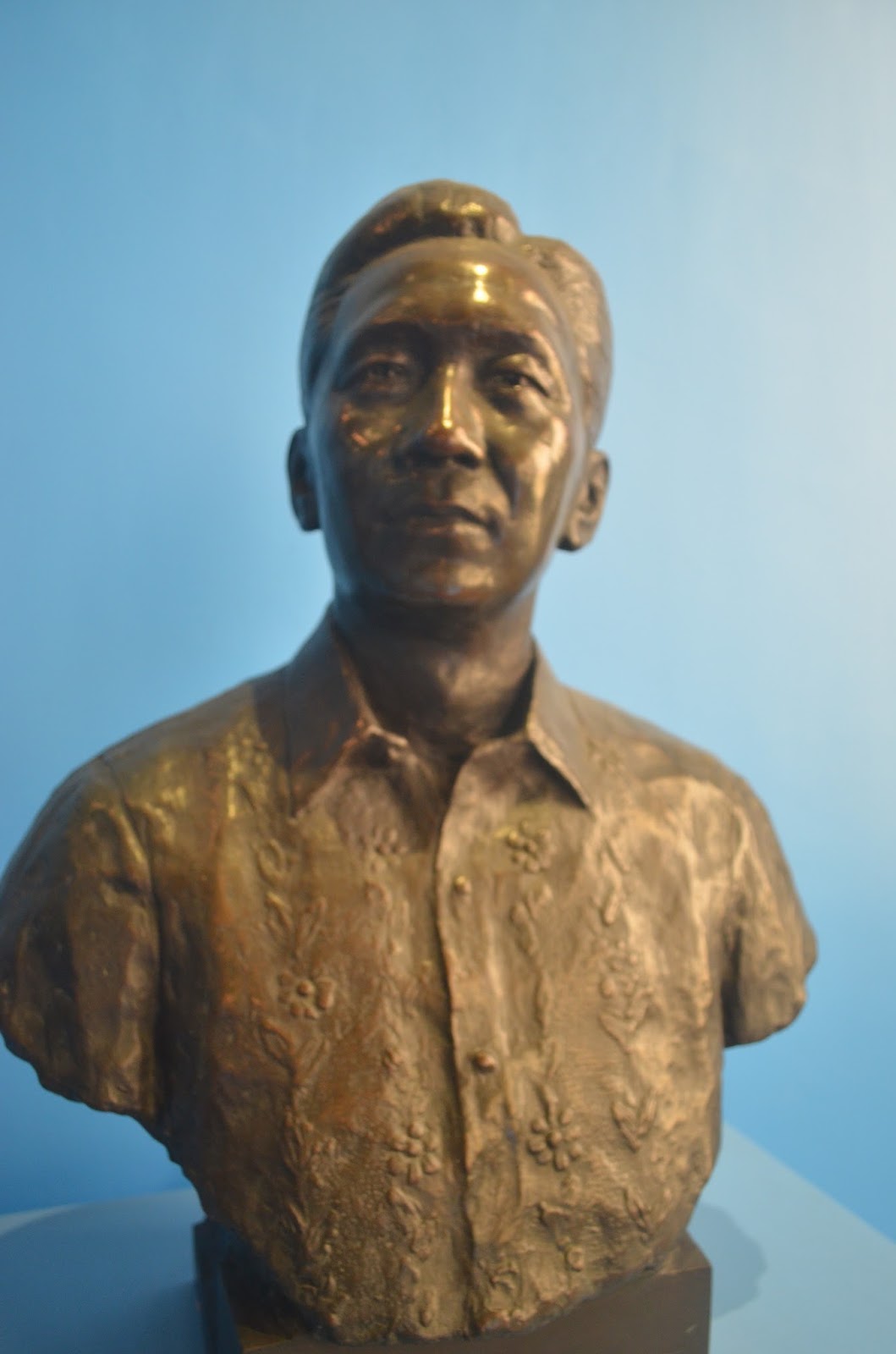 |
| Bust of President Ferdinand E. Marcos |
 |
| Bust of President Manual L. Quezon |
Okay so that's all for the second floor of the National Art Gallery building, let us now go upstairs for more historical and artistic adventure. So the third level of the building was actually the Old Senate Session Hall, and if you want to know its historical background just check the picture down below.


We're really happy that at last we stepped in the Old Senate Session Hall, a historical site where senators during the early centuries do their debates for the greater good of our country.
So in the third floor you can also see different galleries that mainly features Philippine Abstraction and Modernism. There were a lot of art pieces made by various artists. Such as National Artists Victorio C. Edades who spearheaded the modernism in the Philippine Art, Benedicto "BenCab" Cabrera, Vicente S. Manansala, Hernando R. Ocampo, Lao Lian-Ben, Ang Kiukok, Nunelecio Alvarado and a lot more of creative and artistic minds.


We were really thrilled to see the masterpieces of the greatest artists that ever lived in the Philippines and as we walk over the galleries and saw their beautiful artworks, we were really amazed and dumbfounded by the strokes made by their brushes and the way they made those kind of art. How I wish I was also blessed by that kind of talent. hahaha!

Revisiting the National Museum and seeing different works of art and artifacts made by Filipinos made me more proud of being a Filipino and these are the things that we Filipinos should be proud of, because these masterpieces were all proudly Filipino made and with these all I can say is that, I am Shenemar Esteban and I am proud to be Pinoy :)